
SprayLawn Hydroseeding
Toll Free:
888-941-2040
 Care & Watering Your Hydroseeded Lawn
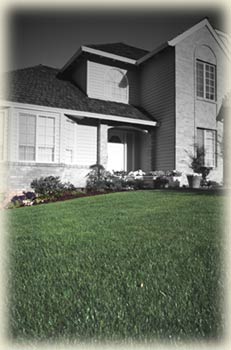 Taking care of your hydroseeded lawn requires a few days of special attention. The most important time in caring for your lawn is during its germination period, where you should try and keep your lawn moist. Please try to follow the watering schedule as follows:
Watering
Spring and Fall Watering Schedule: Temps NTE 70 Deg.
| Day | Frequency | Amount |
|---|---|---|
| 1-13 | 1 to 2 Times/Day (Min) | 20 Minutes (Germination) |
| 13-24 | 1 Time/Day | 25 Minutes |
| 24-44 | 2 Times/Week | 30 Minutes |
| >44 | 1 Time/Week | 35 Minutes |
This is an average watering schedule based on typical lawn conditions. If you have very sandy soil (such as a winter mix top soil) double the frequency shown above and below. If it rains.... you're ok.
If you have an irrigation system, try and set it for the most cycles possible (say 6 to 8 waterings per day) at about 5 minutes per cycle during the germination period. Keeping the mulch mat moist provides the grass seeds optimal growing conditions.
Once your lawn begins to show growth, shift your watering schedule to the post germination watering cycle. This is very important as you need to train the roots to "chase water" and grow deep. It is human nature to "not fix something which works." It may seem counter intuitive to adjust the watering schedule when your lawn looks great, but not adjusting it will acclimate the roots to a high water table and cause wilting during the hot summer heat. Grass roots are healthier when they grow deep and soaking your lawn more and more over a longer period of time promotes deep root embeddment.
Summer Watering Schedule: Temps Over 70 Deg.
| Day | Frequency | Amount |
|---|---|---|
| 1-13 | 3 Times/Day (Min) | 20 Minutes (Germination) |
| 13-24 | 1 Time/Day | 25 Minutes |
| 24-44 | 2 Times/Week | 30 Minutes |
| >44 | 1 Time/Week | 35 Minutes |
Fertilizing
As important as water is, so is fertilizer for your new lawn. We suggest using fettilizers with at least a blend of (16-16-16) EG.
The best fertilizer to use initially is a "starter" fertilizer where the second number in the composition (phosphorus) is greater than the first number (nitrate). In the first year of growth, special attention should be taken to root development. Phosphorus will stimulate root growth and is necessary for the plants development.
You can think of the three fertilizer number as follows: 1st number: top (color enhancing nitrates), 2nd number: down (root developing phosphorus), and the 3rd number: all around (potassium) bloom development (not really important in lawns).
Once your lawn matures, you can begin to use fertilizers with more Nitrogen. A 40-0-0 blend is pure ammonia nitrate and can be considered cocaine for your lawn: it will hyper stimulate the chlorophyl; greening it up real quick and do nothing for the roots. In a month or so, the lawn will return to its original condition having spent all its energy becoming green and have become more stressed than before. We suggest never going over a 2:1 ratio (in terms of nitrogen and phosphorus) in a mature lawn.
As far as when to fertilize: the best indicator is when the grass color begins to "drop off." As your lawn matures, it will absorb more of the applied fertilizer and consequently require less and less applications over time. Because the roots of a new lawn are so shallow, it will be necessary to fertilize within 25-30 days of the original hydroseed application. In the event you have a winter mix for topsoil or very sandy soil conditions, you will need to fertilize more often as the nutrients will rinse through this porous soil more rapidly. In the event we have a lot of rain, the additional water will dilute the existing fertilizer requiring more frequent fertilizing applications.
If your soil has a lot of organic material in it you may experience "nitrogen draft." Nitrogen draft occurs when decomposing organic material leech the soil of its nitrogen in the process of its decomposition. If you notice a lot of organic material (sawdusty, twiggy looking topsoil) you will need to bulk up on your nitrogen for awhile to counteract this. To help expedite the organic materials decomposition, we recommend using Dolomite or Calpril (pellitized lime) as a means to expedite its decomposition. If left untreated, your "hot" topsoil will take a long time to stabilize and cause yellowing.
Do not fertilize in the winter. Your lawn is dormant and requires little to no nutrients at this time. A fall fertilizer should be applied having a 1:2 ratio in terms of nitrogen and phosphorus. Additional phosphorus in the late fall will prepare the roots for winter dormancy.
Weed and feed fertilizers typically can be applied after three mowings of your lawn. Selective herbicides generally require this amount of time for the grass plant to mature in order for the product to be able to distinguish it from weeds. Please consult the product's directions.
